How do I become a Supernode? This is the question aspiring members to NYC Mesh often post to slack. Wide eyed with best intentions, it’s a long path to become a good hub, let alone a Supernode. Technicalities and naming conventions aside, trying to help others for a greater good is the inspiration that keeps the community strong.
When I started my journey with NYC Mesh, it was the same. Looking in the Slack DIY channel for help, as the website leaves some details to fall between the cracks. I had a background that covered the basics, but some details are left to interpretation. Helpful volunteers set me on my way, and after buying hardware, I set up a node. It started simple, a “typical install” with one antenna to uplink to the wider network, and a second to share locally.
I was using this connection as a secondary ISP, mainly for failover reliability. Many devices at home want to reach out to the internet, and I wanted to ensure they could. Sadly, my uplink to Jefferson was not as stable as desired for a reliable backup link, and I quickly learned you solve things by putting in effort. On slack, I saw a channel for the Jefferson hub, its general setup, and went with another volunteer to troubleshoot. Turns out many antennas were “disturbed”, a term I came to learn more as I volunteered with Mesh. Whether due to wind, vandalism, or other causes, they were no longer pointing where they needed to. We resolved them, re-crimped cables, and a month later same issue.
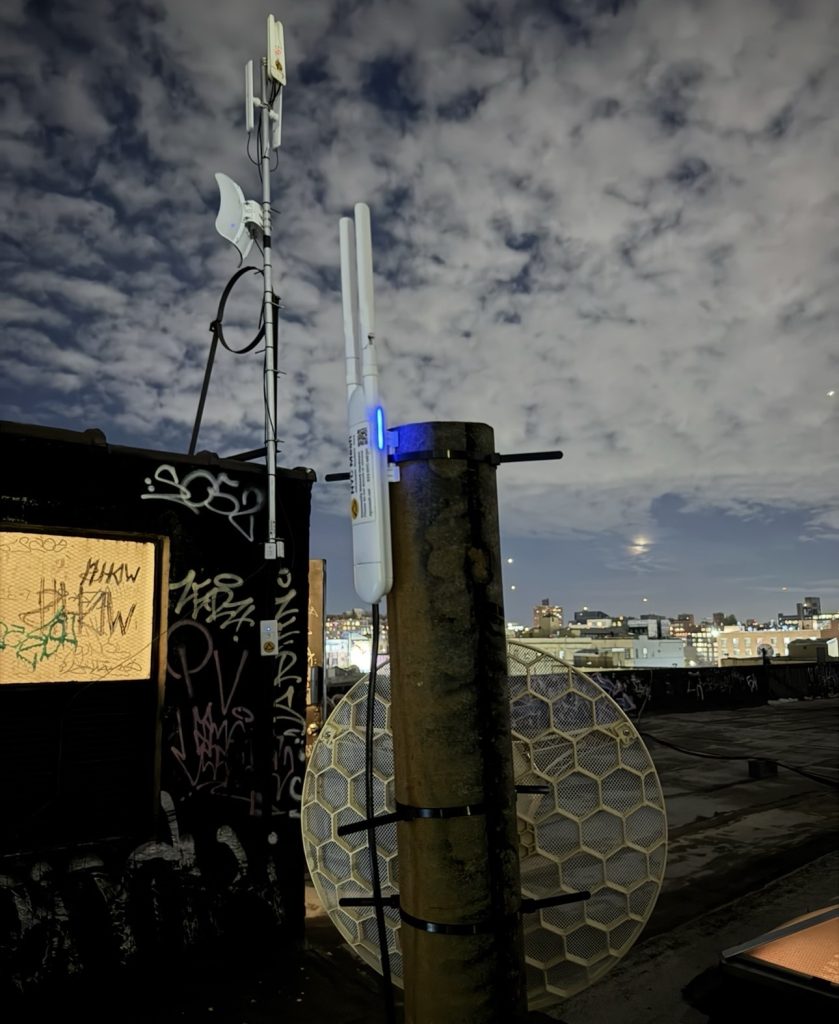
I decided to control what I can, so instead of fully relying on Jefferson, a second antenna pointed toward Vernon. Now my backup ISP had 2 uplinks, and was dually redundant. Very reliable. With 2 LiteBeam antennas, and 1 OmniTik router, I had accidentally short-circuited the path between these 2 hubs, unintentionally. My node was doing more damage than good. NYC Mesh uses OSPF to determine routing, and these 10 costs added to 20, which was less than the defined backup link to Jefferson, so traffic may prefer my (slower) path. Helpful volunteers on slack explained this issue, how to correct it, and I was off again, with new skills and a fancy setup. I would put this knowledge into use many times over, to pay back the cost of learning.
In the pursuit of growth, and sharing the redundancy at my disposal, I converted my node into a hub; Installing sector antennas to further share with the neighborhood, far beyond the block where -NYC Mesh Community WiFi- covered. This promoted my node into a hub, a shiny blue dot on the map. Now others could point their LiteBeam at me, and traffic would flow.
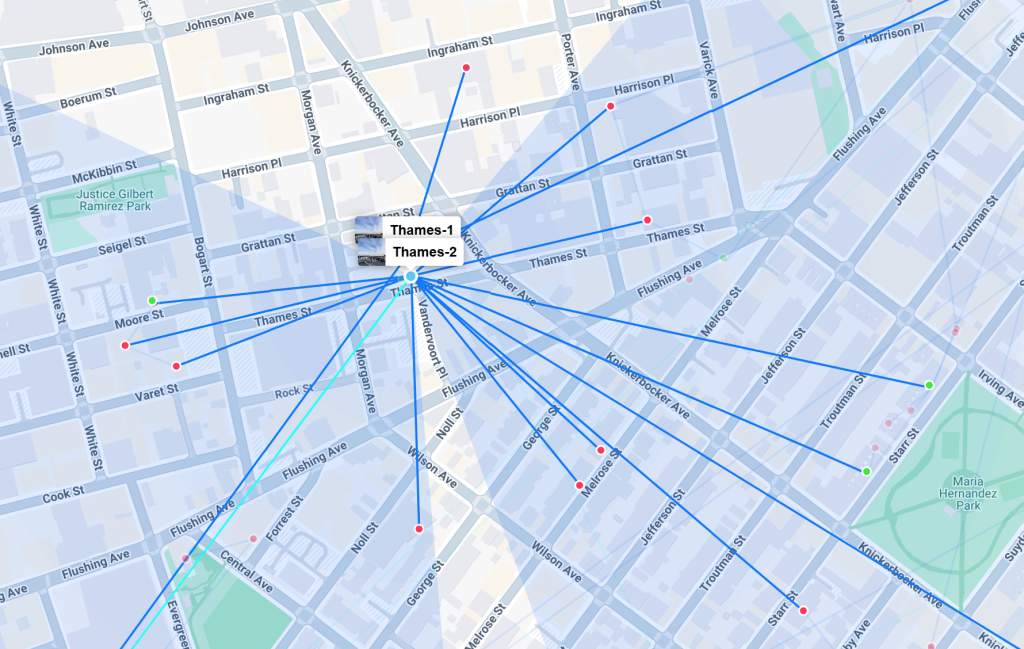
Soon, this backup link was nearing the antenna’s limit (~150 Mbps), with neighborhood traffic consuming an uplink more aligned to a single household. In the spirit of Mesh, this meant heading over to Vernon to increase capacity. This isn’t a setting to flip, or a new price to pay per month, its work. You get what you put in; How well you align your antenna, what type of antenna you put up. The $50 5GHz LBE was at its limit, so we added a $200 60GHz GBE-LR on each end. The 150Mbps was left in the dust by this 1.5Gbps link, and latency dropped from 12ms to 2ms.

If you can reach Vernon, you might as well be at a datacenter. A mature large hub with links across the city. Even Vernon is not considered a Supernode, but along with Saratoga, they form the backbone of Bushwick. Although NYC Mesh is very much a mesh network, at its center, it can be quite hub and spoke. These large hubs are very important points of the network, and they get busy fast. Offloading them in favor of local mini-hubs, what I had built, helps everyone move faster.
With a fancy 1.5Gbps link, it was time to improve routing. The OmniTik is great for the LiteBeam, but with this new antenna, I needed something more. The OmniTik hits a 350Mbps routing cap, and can’t come close to unleashing this new antennas power. I settled on an indoor HAP-ax2 due to its cost, size, and general usability to poke and prod. It was a new AX model, so the legacy AC based scripting of configurations did not apply, along with changes to drivers and chips. All in, we were now distributing 600Mbps on a consistent basis.
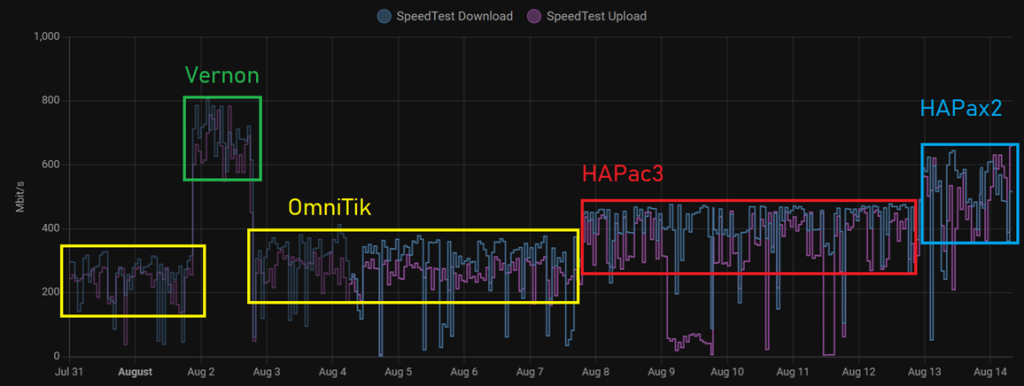
At this point, I had 3 redundant uplinks, excessive symmetrical bandwidth, and unbeatable latency. It was time for Mesh to take over, and become the primary ISP. This setup was providing a fault tolerant option for other members to use, helping the neighborhood grow. A few more antennas went up, mainly to help share this stability to other small hubs, a last man standing in the middle. Another Litebeam to Eldert, and to Hex House. 5 redundant uplinks. Other units in the building bought in, and got connected.
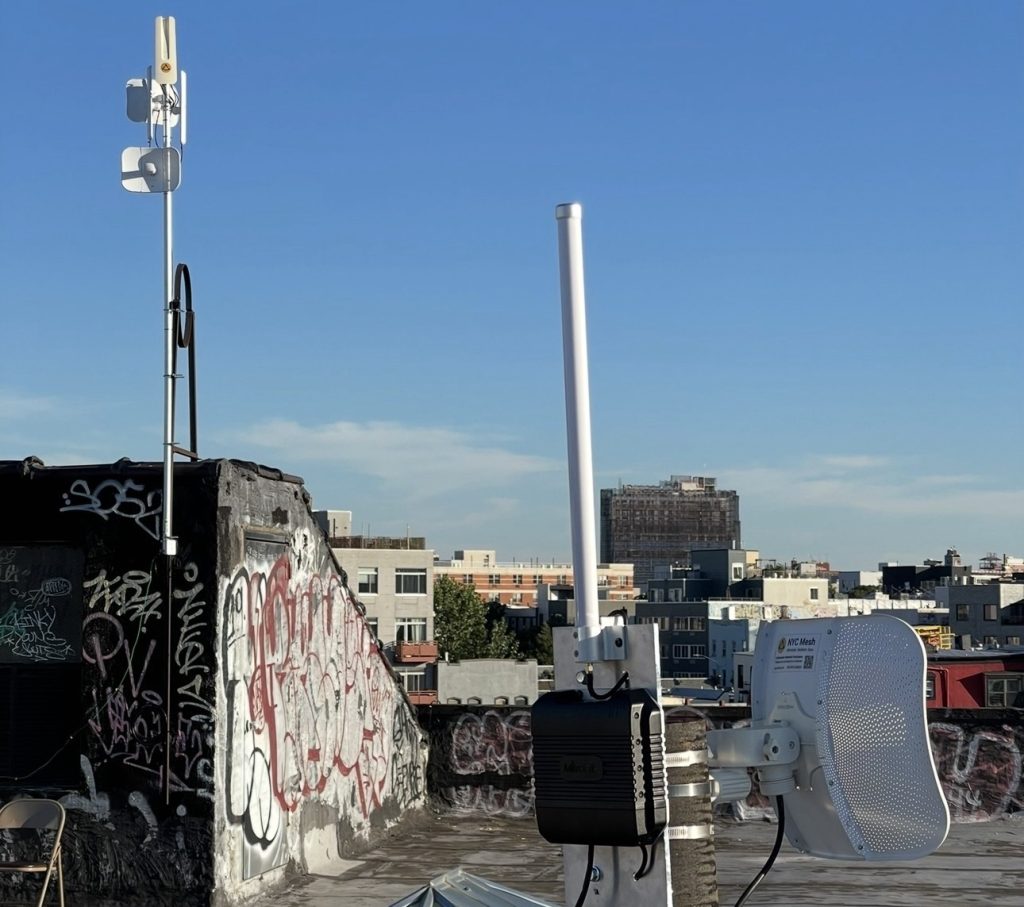
Partnerships with other organizations took advantage, adding a LoRa gateway to infuse the city with sensory devices, helping university projects. Providing connectivity to public access points in parks, community spaces, and small businesses struggling to turn profit with NYC costs. At the heart of it, a Guerrilla install on top of an abandoned factory, left to rot. Seeds rising from the ashes.
If you live in NYC, or want to create something of your own, come join us!